
The Intelligence Revolution is often discussed primarily in terms of artificial intelligence. But AI, powerful as it is, represents only part of a broader transformation.
The deeper change concerns how intelligence is generated, integrated, and used within organizations. Competitive Intelligence (CI) has traditionally helped organizations understand competitors, markets, technologies, customers, and emerging risks. That foundation remains highly relevant, but the environment has changed: information flows continuously, competitive conditions evolve rapidly, and decision cycles are increasingly compressed.
This broader transformation can be understood as a transition from episodic intelligence toward intelligence that is increasingly continuous, AI-enabled, human-centered, and embedded in organizational decision-making. Lenovo and Procter & Gamble (P&G) illustrate two complementary dimensions of this transition.
Lenovo: From Reactive Monitoring to Continuous Intelligence
Traditional Competitive Intelligence frequently operates around defined questions or periodic reporting cycles. This model remains valuable, but increasingly dynamic markets create pressure for organizations to maintain awareness continuously – often before a formal intelligence request is made.
According to a case study published by Contify, an AI-enabled Market and Competitive Intelligence (M&CI) platform provider, Lenovo sought to move its market and competitive intelligence activities from reactive monitoring toward a more proactive model. Contify reports that Lenovo analysts were spending substantial time collecting and compiling external information while decision-makers faced information overload. Lenovo implemented Contify’s platform to consolidate industry, market, and value-chain intelligence and monitor developments including competitor activity, regulatory change, macroeconomic signals, and supply-chain developments (Contify, 2026a).
According to Contify, the system combines strategic-question-driven tracking with automated, role-specific dashboards and newsletters, enabling intelligence to be tailored to different stakeholder needs. Contify reports that the implementation helped redirect analyst effort from manual monitoring toward higher-value analysis (Contify, 2026a).
Contify also publishes a testimonial attributed to Jonathan Quick, Director of Strategy at Lenovo, who states that tailored PC-industry insights, customized reports, and Athena AI automation help Lenovo’s strategy team make “smarter, faster decisions every day” (Contify, 2026b).
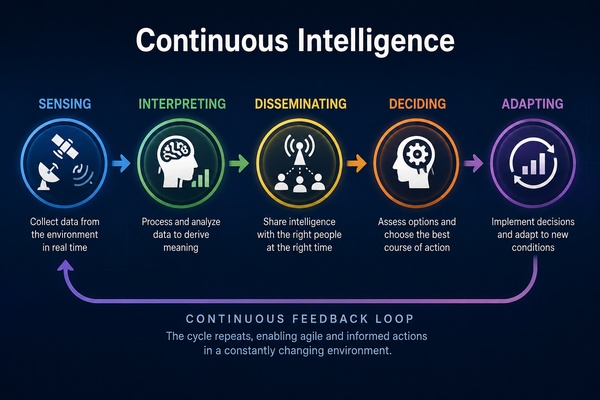
The significance of the Lenovo case is not the adoption of an AI platform alone, but a potential change in the operating model of intelligence. AI-enabled collection and filtering can support more continuous monitoring, reduce information overload, and allow analysts to devote greater attention to interpretation and strategically significant signals. This illustrates a fundamental dimension of the Intelligence Revolution: the shift from episodic intelligence toward continuous organizational awareness.
The objective is not continuous reporting. It is continuous readiness.
P&G: AI at Scale, Human Understanding at the Center
If Lenovo illustrates the move toward more continuous intelligence, P&G demonstrates another dimension of the Intelligence Revolution: the relationship between artificial intelligence and human understanding.
P&G combines a century-long tradition of consumer research with increasingly sophisticated analytics and AI capabilities. Its Analytics & Insights organization traces systematic consumer research at P&G back more than a century, from researchers going door-to-door to understand consumer behavior to today’s combination of direct consumer engagement, behavioral data, advanced analytics, connected technologies, and AI. P&G describes the objective as making consumer understanding and insights a core part of the business model “from design to delivery” (P&G, 2024).
The scale is substantial. P&G reports more than two million consumer research engagements in 2024. In a March 2026 publication, the company describes millions of direct consumer connections annually through methods including conversations in consumers’ homes, observation of everyday activities, shopping alongside consumers, and opt-in behavioral insights from its Connected Home platform. P&G states that these human connections are complemented by AI-enabled tools that accelerate insight generation and analysis of large datasets (P&G, 2026a).
AI has also moved beyond isolated experimentation. P&G reports that ChatPG, its internal generative-AI environment, had grown to more than 30,000 users by January 2025 (P&G, 2025).
At the 2026 Cannes Lions International Festival of Creativity, P&G Chief Brand Officer Marc Pritchard illustrated the limits of AI using ChatPG, asking the system to describe consumer behavior. AI quickly generated a strong starting point, but could not uncover the nuanced cultural truths that emerge from observing people in their everyday lives. These deeper insights, P&G notes, are rooted in human curiosity, empathy, and real-world observation, which help transform information into meaningful ideas (P&G, 2026b).
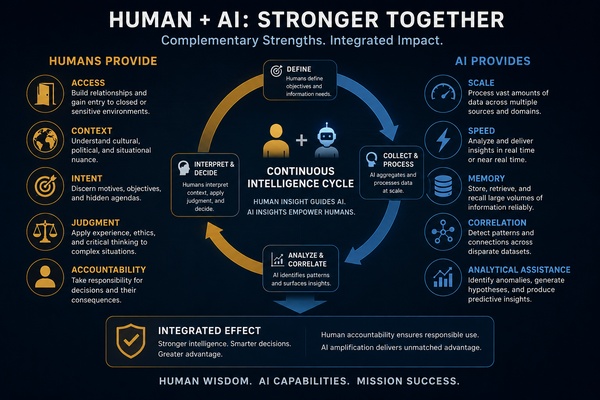
The case therefore illustrates complementarity rather than substitution. AI can expand sensing capacity, process large volumes of information, detect patterns, and accelerate analysis. Human intelligence remains essential for understanding context, recognizing nuances, interpreting why behavior is changing, and determining what a signal means for a decision.
AI for scale. Humans for significance.
What the Two Cases Tell Us
Lenovo and P&G represent different intelligence contexts and should not be generalized too broadly. Lenovo is a vendor-documented M&CI implementation, while P&G provides a company-documented example of large-scale consumer insights and human-AI integration. Yet together they illustrate several developments relevant to the Intelligence Revolution.
Intelligence can become more continuous as technology reduces the effort required for monitoring, filtering, and updating external information. AI can also shift human effort away from some information-processing activities and toward interpretation, contextual understanding, and judgment. At the same time, both cases illustrate ways in which intelligence can move closer to organizational decisions rather than remaining confined to periodic analytical outputs.
This last development connects directly with Competitive Intelligence Embeddedness. Markovich et al. (2019) conceptualize CI embeddedness as an organizational capability reflecting the extent to which management and employees incorporate competitive intelligence into daily organizational routines. Seen through this lens, the important question is not simply whether an organization possesses more information or more sophisticated AI, but whether relevant intelligence becomes integrated into the routines and processes through which people interpret change and make decisions.
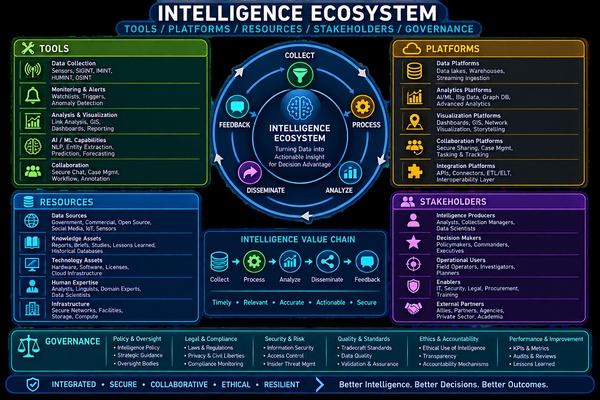
Taken one step further, this points towards an Intelligence Ecosystem connecting technology, information sources, analysts, human intelligence, organizational stakeholders, governance, and decision-makers.
Conclusion: Beyond AI Adoption
The Intelligence Revolution should not be equated with the adoption of generative AI. AI is a powerful enabler, but the deeper transformation concerns how organizations sense their environments, interpret change, combine machine capabilities with human intelligence, and connect intelligence with decisions.
Lenovo illustrates a move toward more continuous, AI-enabled sensing and intelligence delivery. P&G demonstrates that even at substantial technological scale, direct human observation and contextual understanding remain central to insight generation and decision-making.
The foundations of Competitive Intelligence—systematic collection, rigorous analysis, validation, contextual interpretation, ethical practice, and decision relevance—remain essential. What is changing is the speed, scale, continuity, and organizational integration expected of intelligence.
The challenge is no longer simply whether organizations possess good intelligence. It is whether that intelligence is continuous enough to detect change early, technologically enabled enough to operate at scale, human enough to understand significance, and embedded enough to influence decisions while there is still time to act.
That is the Intelligence Revolution in action.
#Continous Intelligence #Human-AI Integration #Intelligence Revolution
References
Contify. (2026a). Intelligence at the Speed of Business: How Lenovo Built 360° Value Chain Resilience with Contify. Source
Contify. (2026b). Market & Competitive Intelligence Solutions. [Jonathan Quick, Director of Strategy, Lenovo, testimonial]. Source
Markovich, A., Efrat, K., Raban, D. R., & Souchon, A. L. (2019). Competitive intelligence embeddedness: Drivers and performance consequences. European Management Journal, 37(6), 708–718. https://doi.org/10.1016/j.emj.2019.04.003 Source
Procter & Gamble. (2024). Celebrating the 100th Anniversary of P&G Analytics & Insights. December 13, 2024. Source
Procter & Gamble. (2025). Meet the 2024 P&G Signal Innovators. January 11, 2025. Source
Procter & Gamble. (2026a). P&G: Celebrating Consumer-First Excellence. March 2026. Source
Procter & Gamble. (2026b). Robots Don’t Build Brands. People Do. July 1, 2026. Source